Showing posts with label Family History Guide. Show all posts

Sunday, December 22, 2019

Researching My Hometown Ancestors

It is nearly Christmas and winter still hasn't arrived for us. We had two weeks where the temperatures got down into the 50s and 60s but this week it has been in the mid to upper 70s again with frequent rain showers. It is hard for us here in Florida to realize that many parts of the rest of the country are having winter storm advisories. With weather like that we really don't get forced into staying indoors for days to do our family history research but when I do get a good chance to research, I want to make sure I am getting the most out of my time. So, here are some suggestions on making sure you are focusing on sources with the potential for high returns.

Map of Ohio where my research is focused.
I am one of those lucky people who don't have far flung ancestors to research. My research focuses on a very small area of Ohio consisting of parts of four counties; Auglaize, Darke, Mercer and Shelby. And within those four counties it is mainly within the four corners area as shown in the red square on the map.

First of all, I want to discuss the general process of finding the sources for your locations. This step, developing a locality guide, can help you learn more about the area you are researching and help you find the important resources that you need to be successful. The FamilyLocket blog and podcast have some great tips on creating locality guides. They have three podcasts on this specific topic: RLP 4, RLP 5, and RLP 18.

Where are some good places to begin developing your locality guide? First, I would suggest using the FamilySearch Wiki. If you aren't familiar with the FamilySearch Wiki, it is "a free, online genealogical guide created and maintained by FamilySearch. It contains links to genealogy databases, websites, other resources, research strategies, and genealogical guidance to assist in the search for your ancestors. Articles included are locality pages for countries around the world and topic pages that include pertinent genealogy record types explaining how to use the record, what it contains, and how to find it." The Wiki is developed and edited by teams of users, much like Wikipedia, who are familiar with the research topic and want to help provide the resources necessary for you to have successful discoveries. The Wiki can be searched by genealogy topic as well as locality. Since the topics are developed by volunteers, some sections may be more complete than others. For example, in my research of Auglaize, Darke, Mercer and Shelby counties in Ohio, I would look up each county in the Wiki to see what information is readily available: Auglaize, Darke, Mercer, Shelby.

Another website that I would use to help develop my locality guide is The Family History Guide. The Family History Guide is generally seen as a tutorial for learning how to use the big four genealogy sites (FamilySearch, Ancestry, FindMyPast, and MyHeritage) but it is also a great resource for finding locality information to help research your ancestors. To find the location information, click on Countries in the menu bar at the top of the Family History Guide web page and select the country you want to research. In my case I selected United States. Once on the US page, I selected Ohio from the list of states under the title bar and before the general lessons on US Records and Searches. On the Ohio page there are a series of general lessons to help you understand researching the state and there is a list of county resources at the bottom of the page. This list has the name of each county and a series of letters (for example, Auglaize A L G U). Clicking on the county name will take you to the FamilySearch Wiki page for that county. Clicking the A links you to the Ancestry card catalog for that location, L goes to the Linkpendium list for that location, G goes to Genealogy Inc's list for the location, and U goes to the USGenWeb page for the location. Each of these sites may provide you additional resources to add to your locality guide.

Google is another source for your research. Make sure you do a thorough search on Google and its various sites. Searching Google can help you find the local historical societies, libraries and museums which may have resources of information that can assist you. The search can also link you with others researching the same families and locations. Searching Google Books can provide county histories and other resources that can help build the historical context for your research. For example, I was able to find a book titled "History of Western Ohio and Auglaize County with Illustrations and Biographical Sketches of Pioneers and Prominent Public Men" published in 1905. These county histories can provide excellent hints for your research.

Newspapers are also an important resource when researching a particular location. I was lucky enough to have several of my local newspapers already online for free. One of my favorite free sites to look up newspapers is Ancestor Hunt. They have a general page about using newspapers for your research and a more specific page for finding resources by state. For Ohio, they have links to several hundred newspapers around the state in various collections. Two of my most used newspaper resources are the Community History Archive of the Coldwater Public Library and the Minster Historical Society's Newspaper Collection. These collections have more than 100 years worth of local newspapers for the Auglaize County area available online. You might also have luck finding local newspapers on the Library of Congress' Chronicling America site. Other locations to look for newspapers are University collections. For example, Bowling Green State University has their collection of newspapers here.

I also suggest that you look at maps for your area as you are researching. Historic maps will show boundary changes and potentially towns that no longer exist. Plat maps will show land ownership changes over time. Current maps will help provide current landmarks for you to use during your research. One of my favorite mapping sites is Historic Map Works. They provide a variety of old maps including plat maps and gazetteers.  Sanborn Fire Insurance Maps can provide details about buildings in an area. These maps show the footprint, construction materials, and floor plans of various building. Examples of these maps can be found in the Library of Congress map collections.

I hope these links will help you develop your locality guide and set you on the way to successful researching. Merry Christmas, Happy Holidays and Happy New Year to all!

Saturday, March 2, 2019

RootsTech 2019 - Saturday - 2 March

Last Day of RootsTech
Well, RootsTech 2019 is now over. It was a great week and the crews did a wonderful job of keeping everything running. Since I was speaking today I decided to take it easy on the classes and try to get a few things done before I left.

Today I attended a joint class by FamilySearch and The Family History Guide called Discover, Gather and Connect Your Family Together. This presentation focused on activities we can do with our families and others to encourage family history. It has been found that children with a knowledge of their family history have greater self confidence, self worth, sense of identity and belonging, and can handle stress better. As they learn about their ancestors they gain a better understanding of their world and the trials and celebrations that have come before them.

Elder Bradley D. Foster said "We want everyone to have that discovery experience, because that is what changes their hearts."

So, how do we get our families excited about family history? FamilySearch and The Family History Guide have provided a variety of activity videos to help us. FamilySearch's activities can be found at https://www.familysearch.org/discovery. The list of activities on The Family History Guide can be found at https://www.thefhguide.com/act-index.html. These activities are designed to be age appropriate and suited to any size family, from the individual up to multiple generations. Families can do simple activities such as recording their ancestor's recipes at https://www.familysearch.org/blog/en/recipes. Or they can take on more complex projects such as recreating a part of an ancestor's life (https://www.thefhguide.com/blog/creating-ancestor-connections-fun-ideas-from-the-family-history-guide-childrens-activities-section). Check out the activities pages and see which ones are designed for your family.

I also attended the BYU Family History lunch. The presenter talked about the Family History program at BYU and some of the innovative projects the students are working on. These projects included the Tree Sweeper and Virtual Family Tree. Information about their projects can be found at https://fhtl.byu.edu. They also discussed the Family History degree program and the conferences and webinars they produce.
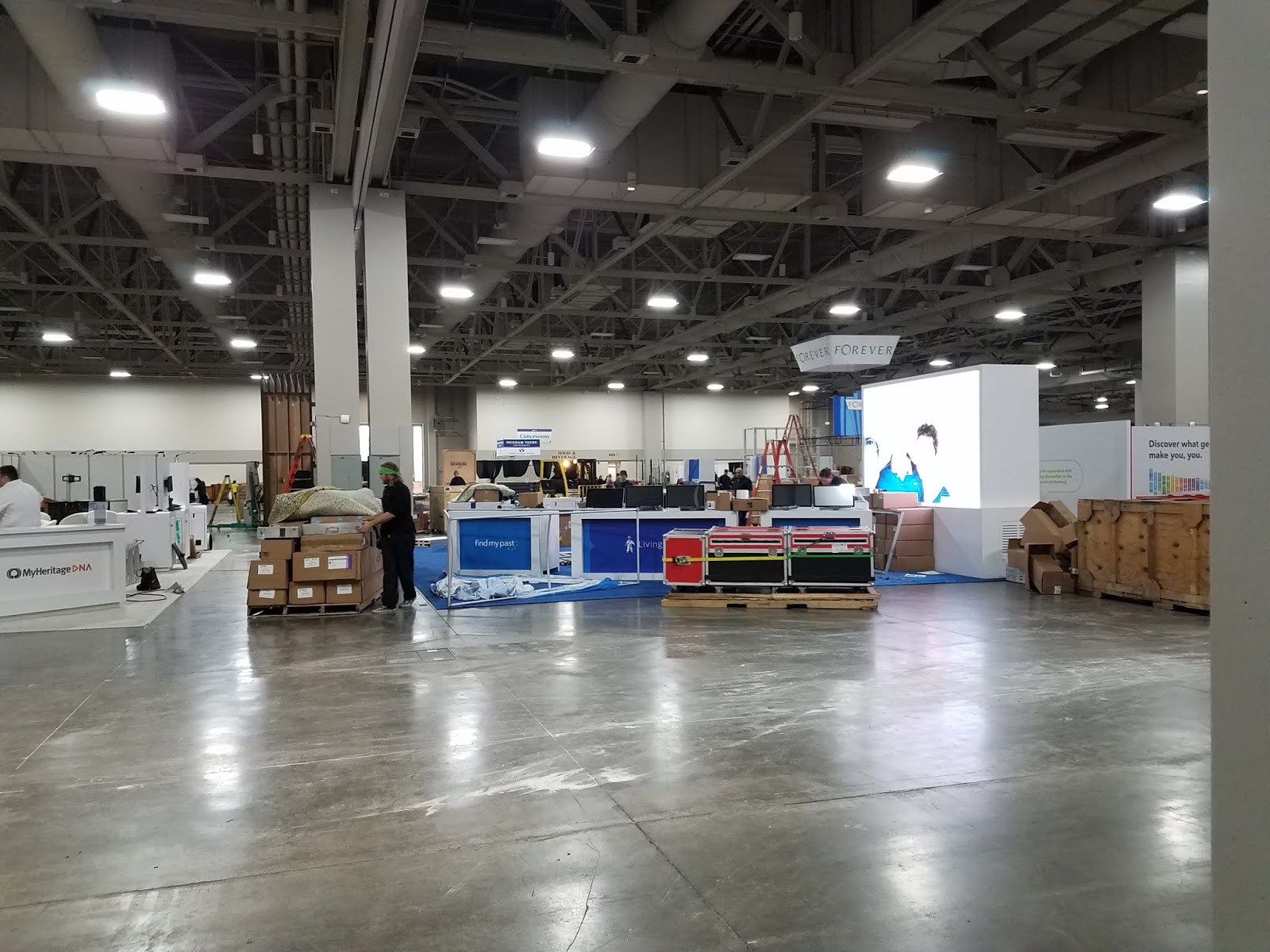
Tear down of RootsTech 2019

My talk on the Tour of Online European Archives went well. I had good attendance considering the location of the classroom and it being the last class session of the conference. The audience had lots of questions about their favorite archives and seemed to be genuinely interested in the topic.

Now the crews are taking down the conference and getting ready for the next event. We will all have to wait another year for RootsTech 2020 which will be held on February 26-29. I hope to see my friends, both new and old, there next year.


Saturday, March 3, 2018

RootsTech 2018 - Day 3

Day 3 of RootsTech started with Scott Hamilton, Olympic gold medalist, giving a key note talk on the challenges he has faced in his life and how his family supported him. He discussed being adopted, having several bouts with cancer, losing his mother to cancer, losing his father while he was away announcing an Olympics, being with his coach the day before he died, his marriage and two biological children, serving in Haiti in disaster relief, and adopting two Haitian children. After his talk, representatives from FamilySearch provided Scott with a history of his adopted family and some of the interesting stories associated with them. Later, he was informed that FamilySearch had researched his biological family and will be reuniting them later this week. It was an incredible story.


Additionally we heard from the producer of Relative Race, Dan Debenham. This is season 3 and their 90 minute premier will be airing this Sunday at 7:00 pm Mountain Time on BYUTV. You can watch it on https://www.byutv.org/relativerace if you don't have BYUTV on your provider. If you haven't heard of this show, I describe it as being similar to Amazing Race but their destinations are relatives they have not known. The challenge is that, as they cross the country, they are not allowed to use any technology other than old flip phones and paper maps. In the past, they have reunited adoptees with their biological family members, found long lost relatives, and introduced contestants to unknown relatives. They had a Q&A session with two of the teams, Red and Green. If you are interested in being a team on future seasons you can apply at http://www.trrcasting.com. During the Q&A session we were told there would be a significant twist and that you should watch Team Blue during the premier.

Relative Race Producer Dan Debenham during the Q&A session

FindMyPast discussed many of their new collections. Their US Marriage collection now contains over 280 million records and another 100 records will be added this year, making the total number of names over 400 million. They are continuing to work on adding records to their US Catholic archives by adding 200 New York parishes this week and will continue to roll out areas including Cincinnati, Baltimore and other diocese over the rest of this year. They are also continuing to add records to their Scotland, Ireland and England Catholic collections. FindMyPast also announced the release of a combined tree in partnership with FamilySearch. This combined tree can be found at www.findmypast.com/new-tree.

One of the sessions I attended was Beyond Subscriptions - 25 Free Genealogy Websites. This presentation talked about some of the top sites to consider when doing your research. Their top picks for initial research were FamilySearch, Cyndi's List, US Genweb and World Genweb. They also discussed libraries and recommended starting your research with the collections at Allen County Public Library and Midwest Genealogy Center. They also reminded us to discover the collections at the local libraries and universities. Cemetery sites, such as BillionGraves, FindAGrave and a variety of state cemetery projects can provide a wealth of information on your ancestors. Military records can be found at a variety of sites including Preserve the Pensions (War of 1812), and the Patriot and Grave Index from the Sons of the American Revolution (SAR).

The number of online searchable books has increased greatly over the last couple years. Some of the recommended sites include the Digital Public Library of America, Internet Archive, and FamilySearch Family History Books. Passenger lists for the majority of immigrants can be found at Castle Garden (1820-1892) and Ellis Island (1892-1954). They also suggested a few ethnic sites including AfriGeneas, JewishGen, and Native Web Genealogy.

The last class I attended was by The Family History Guide. The Family History Guide is a non-profit 501.3c organization. It's resources are free and will always remain free. The site is available in multiple languages and is a great resource for researchers. They are an official training partner for FamilySearch and provide in depth tutorials for FamilySearch, Ancestry, MyHeritage and FindMyPast. You can even track your progress on each of the training modules. There are many age appropriate family history activities included that can help you encourage your children to participate in research. Another great part of the site is the Countries tab. This tab includes hints and links to site that have information on how to research each country. It even goes to the county level in the US.

This was another great day of learning at RootsTech. Tomorrow is Family Discovery Day and many more classes. I hope you are all taking these tips and finding new research ideas.